初谈宋尚节
(接上文)
草湖基督教堂之行
2. 林振珍纪念室
宋尚节奋兴会布道会
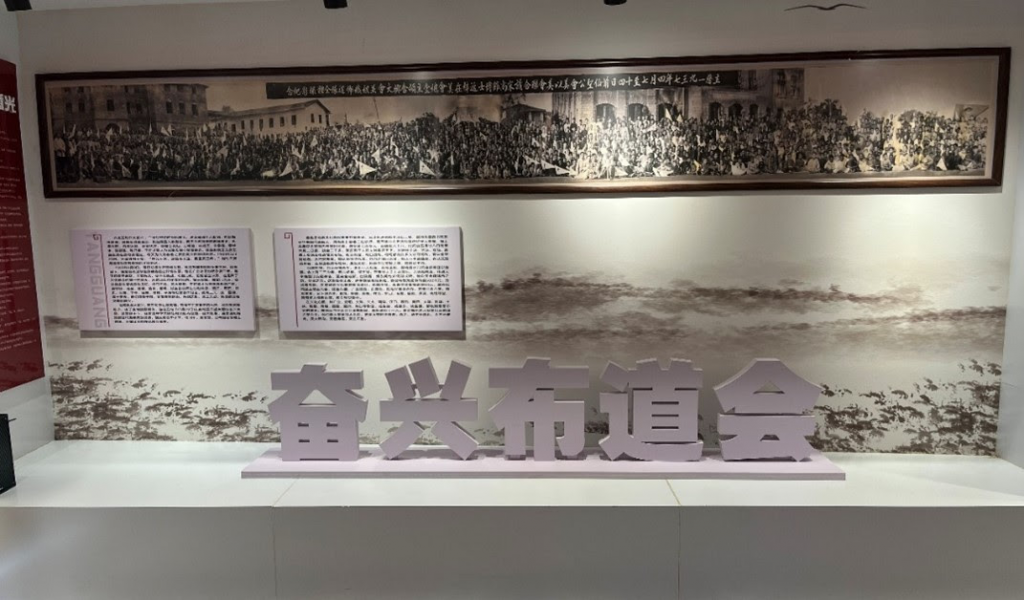
林振珍纪念馆里有一个专栏,介绍宋尚节奋兴布道会,标题:主曆一九三七年四月七日至十四日普仙聖公會美以美聯合會請宋尚節博士返梓在美會總堂主領奮興大會並組織佈道隊全體攝影紀念。上图照片拍摄于 1937 年,当时宋尚节在莆田举办了一场奋兴会。照片中有上千人参加,拍摄技术在当时已相对清晰,宋尚节的脸部轮廓都清晰可见。
黄媛传道介绍说,当时一位老人回忆:“他亲眼见到宋尚节在圣路加医院搭台讲道。讲道结束后,宋尚节邀请需要祷告的人留下,他便为他们一一祷告。留下的人中有身体有疾病的,也有瘸腿的。宋尚节特别为其中两人祷告,其中有一个人当他得医治后,心里还很怀疑,觉得不可信。他带着怀疑的态度说:‘太神奇了,我的腰竟然直了!’他走了几步,忽然想起说:‘我的拐杖呢?’眼睛往后找,于是他的腰一下子又弯下去,再也站不起来了”。
施伟《献祭者》中也讲到,这位老人当时是十三岁姓林的小男孩:“下午,爸爸带他去见主仆宋尚节,他拉着我的手,摸着我的头,问我读经祷告的情况。我问他:‘为什么被按手的,有人痊愈?有人不痊?’他坦然说:‘因为被按手的人的信心不同,所得的医治也不同。’爸爸请他为我祷告,他祷告毕,我们告辞而去。”
宋尚节就像一团火,他走到哪里,就给哪里带去复兴。
退休的陈国恩老牧师补充说:“照片里有人拿旗,你们知道那是干什么的吗?那是布道旗。拿布道旗的人说明他们领受了呼召,都要去为主布道传福音的。”
上图照片下面的文字不是讲1937年宋尚节带领的大复兴,而是在讲1909年兴化的大复兴的。展厅为什么要这样设计呢?他们想要说明的是,为什么莆田教会能出宋尚节呢?因为莆田有培养宋尚节的土壤。这块土壤中主要的事件是1909年兴化的大复兴。文字是这样描述的:
兴化五旬节大复兴,二十世纪初的兴化教会,过分强调个人影响,仰仗物质刺激,忽视圣灵的感动,其结果虽入教者众,而不少却是来吃教依教者,外表兴旺,内里冰凉,识者忧之,普鲁士夫妇 (Dr and Mrs. William Brewster)……宋学连……等人为此率众禁食祷告,美籍传教士万明治女士 (Missionary Miss Winnie Wilson) 函告其在美母亲撒拉,每天为兴化教会之灵性复兴而恳切祈求。1909年3月23日,万母致书于女:“神允所求,深信书未达,而圣灵已降。”[2] 当时只有海运每封信五星期后才能到达。
1909年4月9日,莆田总堂举行受难礼拜,林鸿万痛表耶稣受难苦况,闻着泪下,
晚聚会有道学生薛明春站起立忏悔认罪,曾在广业牧区分肥杂费二元,痛苦自责,并退款,全场听众,受圣灵感动,心如刀扎,纷纷起来认罪,这是将于兴化教会的第一把火。
结果,台下许多人老少都站起来认罪悔改。宋尚节在《灵力激光》一书中也提到这一幕,并记载当时在这场聚会里,教会共收回五百个足球——那些原本被孩子们偷走的足球。当时宋尚节9岁。他于1922年美国下乡布道期间梦到这次兴化大复兴的场景,而且分毫不差。十七年后,在1937年11月8日,当宋尚节返回中国来到婶婶家时,这个兴化大复兴的场景再次如放电影一样一幕幕浮现在他眼前。[3]
可以说,这场复兴极大影响了宋尚节,使他后来每一场奋兴会都强调认罪悔改,并深刻改变了许多人。所以,当有人问宋尚节的奋兴会为什么会大有能力呢?其中一个关键原因就是“认罪悔改”。
[1] 施玮:《献祭者——宋尚节传》(The Sacrifice: John Sung),洛杉矶:灵性文艺,2019,543.
[2] 施玮:《献祭者》(The Sacrifice),69-71。
[3] 施玮:《献祭者》(The Sacrifice),239-241。
An Initiative Reflection on John Sung
(continued from the above)
Journey to Caohu Christian Church
2. Lin Zhenzhen Memorial Room
John Sung Revival Meetings
In the Lin Zhenzhen Memorial Hall, there is a special column introducing John Sung’s revival crusades. The title reads: “From April 7 to 14, 1937, the Episcopal Church of Puxian, together with the United Methodist Episcopal Church, Invited Dr. John Sung to Return to His Hometown to Lead a Revival Crusade at the Main Hall of the American Church and Organized the Evangelistic Team, All Captured in a Commemorative Photograph.” The photograph above was taken in 1937, when John Sung held a revival meeting in Putian. Over a thousand people attended, and the photographic technology of the time was relatively clear, making John Sung’s facial features easily recognizable.
Minister Huang Yuan introduced that at the time, an elderly man said: “He personally saw John Sung preaching on the stage at St. Luke’s Hospital. After the sermon, John Sung invited those who needed prayer to stay behind, and he prayed for each of them individually. Among those who remained were people with illnesses, including some who were lame. John Sung prayed especially for two of them. One of them, after being healed, still doubted in his heart, thinking it was unbelievable. With a doubtful attitude, he said, ‘Amazing! My back is straight!’ He took a few steps, then suddenly remembered and said, ‘Where is my cane?’ As he looked back, his back immediately bent again, and he could no longer stand.”
Shi Wei’s book Sacrifice also recounts that this elderly man was a thirteen-year-old boy surnamed Lin:
“In the afternoon, my father brought me to see the Lord’s servant John Sung. He held my hand, touched my head, and asked about my Bible reading and prayer life. I asked him, ‘Why do some people get healed when the hands are laid on them, while others do not?’ He replied calmly, ‘Because the faith of those upon whom hands are laid differs, and the healing they receive differs as well.’ My father asked him to pray for me. After he prayed, we took our leave.”[1]
John Sung was like a fire; wherever he went, he brought revival.
Retired Pastor Chen Guoen added: “In the photograph, some people are holding flags. Do you know what those flags are for? They are evangelistic flags. Those holding them had received the call and were committed to preaching the Gospel for the Lord.”
The caption below the photograph does not describe the 1937 revival led by John Sung, but instead refers to the 1909 revival in Xinghua. Why is the exhibition designed this way? The curators wanted to show why the Putian church produced John Sung: because Putian had the spiritual soil to cultivate him. The most significant event in this soil was the 1909 Xinghua revival. The description reads:
During the Pentecostal revival in Xinghua, at the beginning of the twentieth century, the church overly emphasized personal influence, relied on material stimulation, and neglected the work of the Holy Spirit. As a result, although many joined the church, many did so merely for the benefits of religion. Outwardly the church seemed prosperous, but inwardly it was cold. Those who understood this worried. Mr. and Mrs. William Brewste…… Song Xuelian……, and others led the congregation in fasting and prayer. Missionary Miss Winnie Wilson in America wrote to her mother Sarah Wilson, earnestly praying each day for the spiritual revival of the Xinghua church. On March 23, 1909, Sarah wrote to her daughter: “God has granted the request; I firmly believe that even if the letter has not arrived, the Holy Spirit has already descended.” At that time, mail by sea took five weeks to arrive.
On April 9, 1909, Putian Main Hall held a Good Friday service. Lin Hongwan vividly described the suffering of Jesus, moving the congregation to tears. In the evening meeting, a theological student, Xue Mingchun, stood up to confess his sins. He returned two yuan that had been improperly collected in the Guangye parish, expressing deep remorse. The entire audience, moved by the Holy Spirit, felt as if their hearts were pierced by a knife, and many stood up to repent. This was the spark of the first revival in the Xinghua church.
Many young and old in the audience stood to repent. John Sung also mentioned this scene in his book The Power of the Spirit, noting that the church collected back five hundred soccer balls—those originally taken by children. At the time, John Sung was nine years old. During his 1922 rural evangelistic trips in the United States, he dreamed of the Xinghua revival scene, recalling it in detail.[2] Seventeen years later, on November 8, 1937, when John Sung returned to China and visited his aunt’s home, the revival scene once again appeared vividly before his eyes, like a movie playing.[3]
This revival greatly influenced John Sung, shaping his later crusades to emphasize confession and repentance, profoundly transforming many people. Therefore, when asked why John Sung’s revival meetings were so powerful, one key reason was the practice of confession and repentance. (to be continued)
[1] Shi Wei, The Sacrifice: John Sung (Los Angeles: Spiritual Literature and Arts Press, 2019), 543.
[2] Shi, The Sacrifice, 69-71.
[3] Shi, The Sacrifice, 239-241.